We advanced our sustainability efforts and achieved zero Scope 1 and Scope 2 emissions
Our sustainability goals guide our work toward a more sustainable future. We aim for a healthy and functional work community, the sustainable use of energy and resources, and the continuous improvement of our operational quality. We are committed to promoting the UN Sustainable Development Goals broadly—from environmental protection and economic growth to social equality.
In 2025, sustainability goals were integrated even more strongly into our performance management system and were increasingly visible as a concrete part of our daily work. We made significant progress in our sustainability efforts and achieved zero Scope 1 and Scope 2 emissions. During the year, we also met our supply chain sustainability targets, as well as several of our safety goals.
In February 2026, we were awarded a Silver Medal in the EcoVadis sustainability assessment. We are particularly pleased that we succeeded in increasing our score compared to the previous year.
_ev_recognition.png?sfvrsn=f95ab0c4_11)
Safety
- Target: 0 accidents and 67 safety walks
- Result: 2 accidents and 68 safety walks
During 2025, production facility employees had personal targets for conducting safety walks and reporting safety observations. No accidents occurred at our production facilities, which demonstrates a high standard of safety work.
Unfortunately, however, two commuting accidents occurred during the year. These accidents resulted in a total of seven days of sick leave. As a corrective measure, we reviewed safe practices for both work and off-duty time, with a particular focus on commuting safety.
.png?sfvrsn=9ee74d57_6)
Picture 1. Accidents and accident frequency rates 2023-2025.
.png?sfvrsn=1d419e12_5)
Picture 2. Development of safety walks and reported safety observations 2023-2025
Occupational wellbeing
- Target: eNPS 30
- Result: eNPS 9
We monitor the wellbeing of employees by means of regular review and target setting discussions together with occupational wellbeing surveys. Our teams have their own discussion routines that provide supervisors with feedback and allow them to monitor occupational wellbeing factors on a regular basis.
The result of our occupational wellbeing survey conducted in spring 2025 was an eNPS (employee Net Promotor Score) of 9. Altogether 89.8 % of employees rated their current work ability as being good or very good. The overall score for occupational wellbeing also decreased from 3.97 in the previous year to 3.88. Although we are satisfied with these results, we continue to focus on clear targets, processes, communications and responsibilities.
The Algol Group offers its personnel safety and sustainability courses through a shared e-Academy training portal. Training on Algol's Code of Business Conduct is renewed every two years. At the end of the year, several employees' previous completions expired, and there was insufficient time to renew them before the year-end, which is reflected in a low completion rate. As a corrective measure, we will ensure that all expired trainings are completed during the early part of the year.
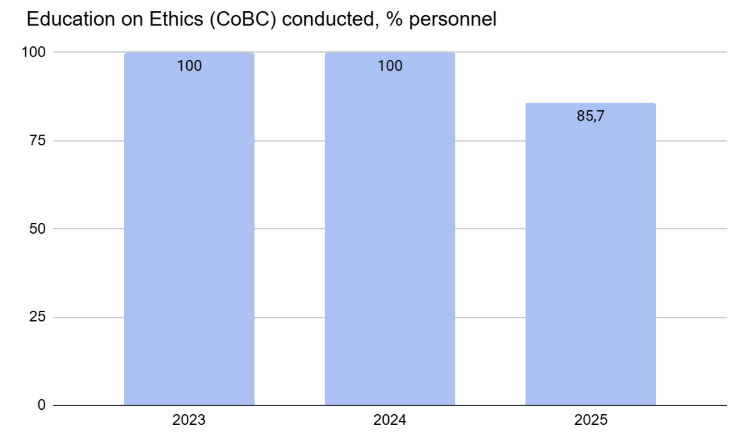
Picture 3. Completed Algol Code of Business conduct training % / personnel 2023-2025.
Supply chain sustainability
- Target: 20 supplier evaluations completed
- Result: 21 supplier evaluations completed
We require all our suppliers and subcontractors to sign our Supplier Code of Business Conduct. In addition, we have guidelines and principles for selecting and evaluating cooperation partners. New suppliers are also carefully evaluated from the perspective of sustainability before being approved.
Environment
- Target: Sustainable use of resources and reduced emissions
- Result: We achieved zero Scope 1 and Scope 2 emissions
As a distributor and packer of chemicals, the most significant environmental impacts are caused by the use of resources in our own production facilities, the storage of our products, and transportation. In 2025, we continued work to prevent the generation of waste due to product obsolescence.
We improved shelf-life monitoring, optimised purchasing volumes, and collaborated closely with actors across the supply chain. Despite these measures, the total amount of waste did not decrease from the previous year’s level. However, we did succeed in slightly reducing the amount of waste classified as hazardous.
For 2026, we have decided to implement systematic monitoring of expired products and the resulting waste to target reduction measures more effectively.
We set a goal to achieve zero Scope 1 and Scope 2 emissions, a target we successfully met in 2025. This result was achieved by the Kvarntorp site switching to biodiesel, complementing our previous measures in utilising renewable energy. Reaching these targets in 2025 was further enabled by earlier changes, such as the adoption of renewable electricity and the Turku site’s transition to renewable fuels.
In 2025, we also advanced the definition of our Scope 3 emissions by collecting emissions data from our product manufacturers, suppliers, and transportation service providers. To date, we have specifically mapped supply chain emissions, such as subcontracted transportation and the climate emissions related to our suppliers' production processes. We will continue this systematic work in the coming years.
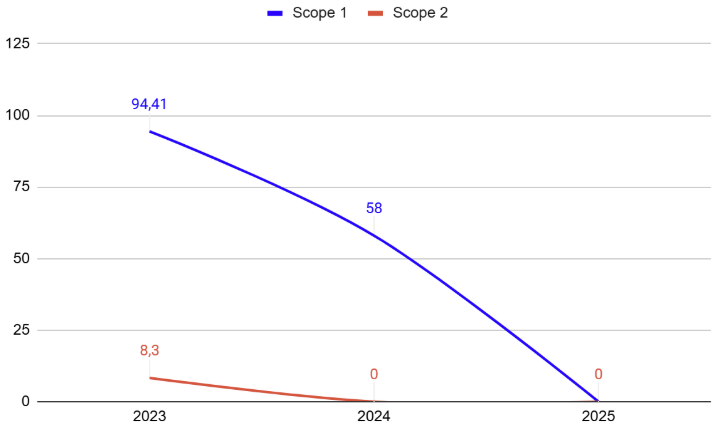
Picture 4. Scope 1 and scope 2 emissions, 2023-2025.
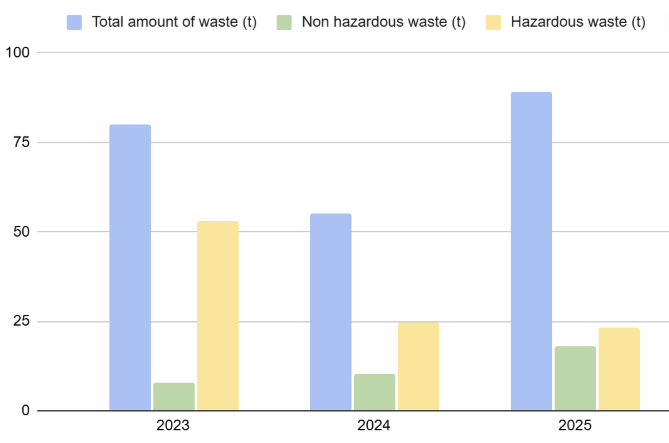 Picture 5. Waste volumes in 2023-2025.