Enhance powder flowability and prevent caking with Evonik silicas and silicates
Good flowability is crucial for the proper handling, easy discharge from silos and precise dosing of powdered ingredients across various industries. However, many powders are naturally cohesive or tend to cake due to pressure, transport or climate conditions, posing processing challenges. Evonik's AEROSIL®, SIPERNAT® and ZEOFREE® silicas and silicates offer an effective solution, transforming cohesive powders into free-flowing materials and acting as highly efficient anticaking agents.
Mechanisms of flow aids in powder types
Evonik silicas and silicates function differently depending on the nature of the host powder.
Dry, hard powders: Surface roughness and spacing
In dry powders, particles stick together primarily due to Van-der-Waals forces. Flow aids are very fine powders that cover the host powder's surface, creating a surface roughness. This process reduces the attraction forces between particles by keeping them apart, effectively acting as a spacer.
- Mixing: Intensive mixing is recommended to thoroughly disperse the silica agglomerates and achieve uniform coverage.
- Addition Level: A low addition level, often below 1%, is typically sufficient.
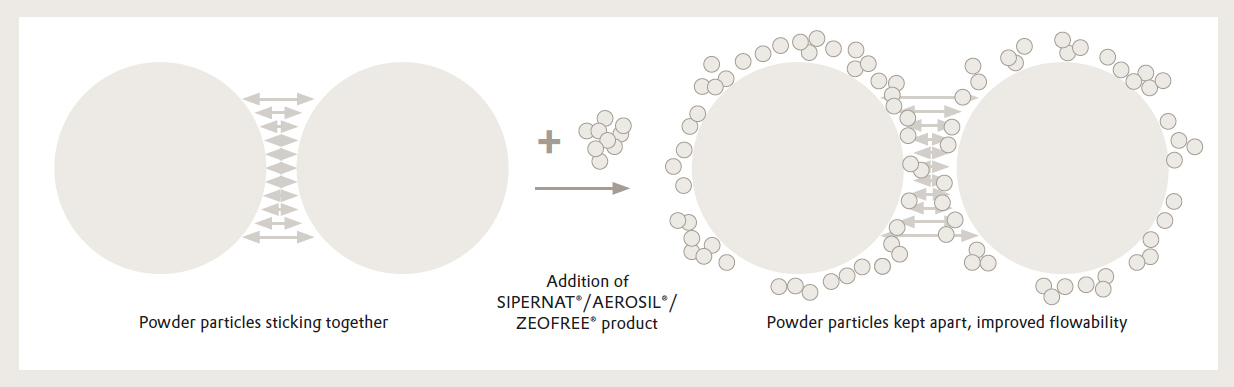
Evonik silicas and silicates cover the host powder’s surface and act as a spacer.
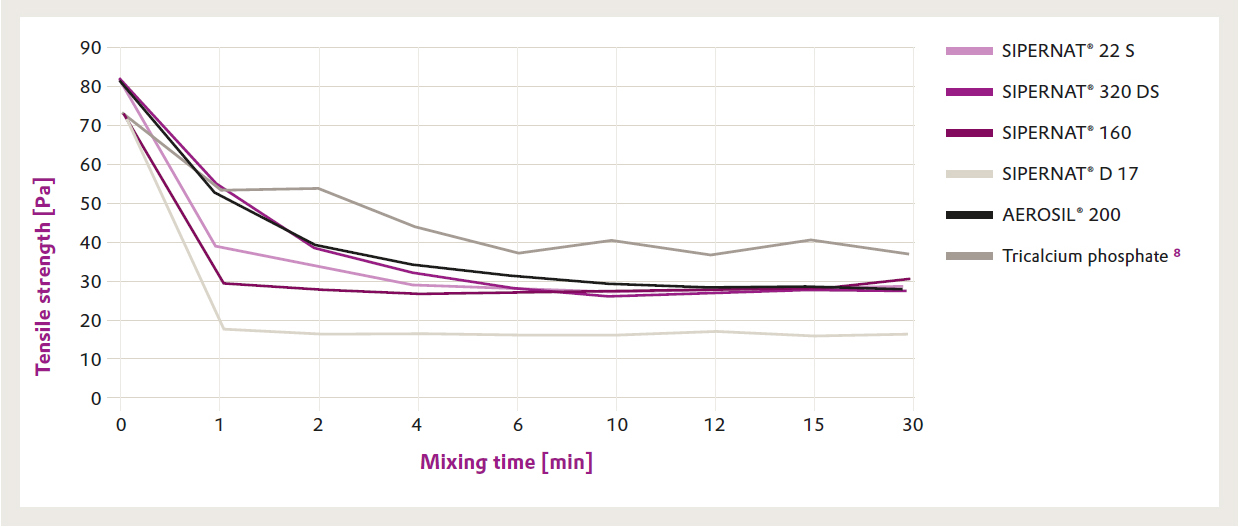
Tensile strength of corn starch with 0.2 % flow aid according to mixing time.
Tensile strength is measured to evaluate flowability. High values for tensile strength refer to bad flowability, low values correspond with good flowability. After a short mixing time of 1-2 minutes, powder flowability improves with the use of all flow aids. Evonik silicas decrease tensile strength significantly more than tricalcium phosphate.
Wet, hard powders: Liquid absorption and capillary forces
Poor flow in wet or hygroscopic powders results from liquid films on the particle surface, which form a bridge between single particles, essentially "gluing" them together. The attraction is described by capillary forces.
- Hydrophilic Silicas/Silicates: Highly porous products like SIPERNAT® and ZEOFREE® are excellent free-flow and anti-caking agents because they can absorb the liquid film into their pores via capillary action.
- Hydrophobic Silicas: These are highly efficient when water is the wetting agent. They do not absorb the water film but float on it, spacing particles apart and preventing further moisture uptake.
- Mixing: Gentle mixing conditions are essential to protect the porosity of hydrophilic silicas and prevent hydrophobic silicas from being wetted out by high shear forces.
- Addition Level: For hydrophilic products, 0.5–2%; for hydrophobic products, 0.1–0.5%.
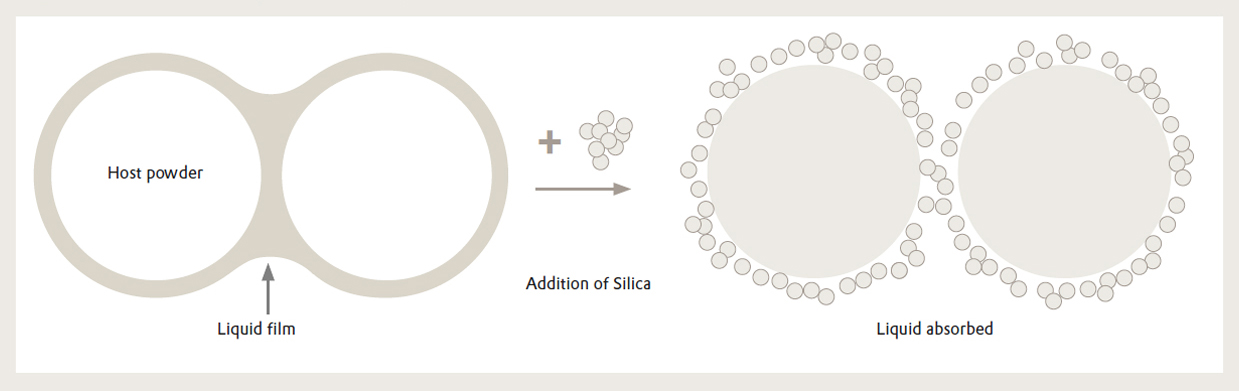
Silica absorbs liquid from a wet powder’s surface.
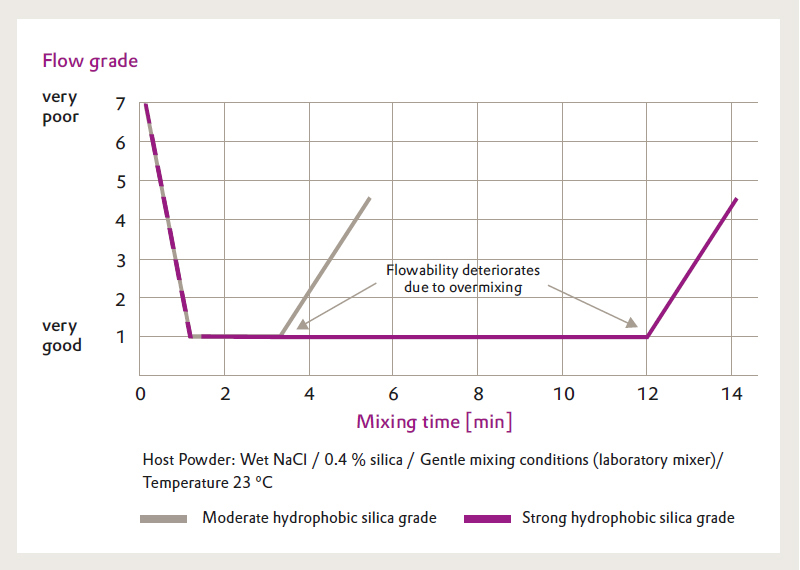
Sensitivity of hydrophobic silica grades to overmixing.
Soft powders: Preventing deformation and capture
Soft or thermoplastic powders (e.g., fats, waxes, emulsifiers) tend to cake heavily because they are deformed and stick together under pressure or rising temperature.
- Mechanism: Evonik silicas and silicates cover the surface to prevent the particles from sticking together. Part of the anticaking agent may penetrate into the soft powder's surface during storage, reducing its efficiency.
- Mixing: Moderate mixing is needed to disperse the silica but avoid damaging the soft powder particle structure.
- Addition Level: A high addition level, up to 5%, is often required to ensure long-term flowability.

Soft powders capture part of the anticaking agent.
P (Pressure): Represents the weight of the product in a silo or the stacking of bags on a pallet.
T (Temperature): Represents environmental heat or friction during transport that softens the powder (common with fats, waxes, and emulsifiers).
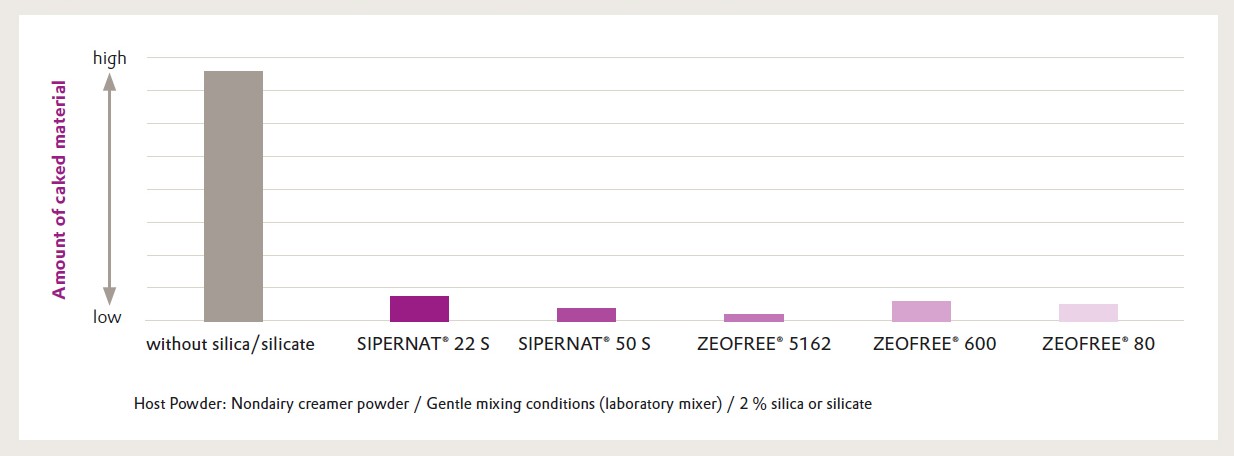
Evonik silica and silicate products reduce the tendency of a soft powder to cake.
For complete details, diagrams and specific product recommendations, you can access the original technical information brochure: TI 1351: Evonik silicas and silicates as flow aids and anticaking agents.